B
Beyond the Hype:
How AI Is Shaping the Future of the Giant Screen Industry
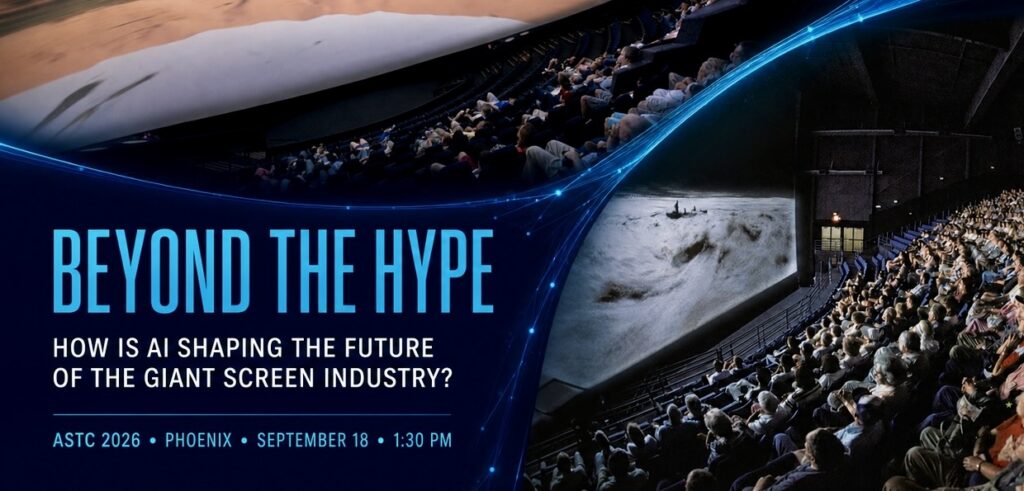
GSCA brought its “Beyond the Hype” conversation on artificial intelligence to ASTC 2026, inviting participants to explore how AI is already affecting giant screen filmmaking, theater marketing and audience development, fundraising, leadership, and organizational operations.
Rather than debating whether AI should be used, the session focused on a more practical question: How can our field use it responsibly while protecting trust, authenticity, privacy, and creative integrity?
Participants broke into four discussion areas:
Giant Screen Content & Creative Integrity
The conversation centered on the difference between using AI as a production tool and using it to create material audiences may believe is real. Participants discussed AI-supported workflows including pre-production, storyboarding, image enhancement, upscaling, cleanup, and post-production, while raising important questions about documentary integrity, disclosure, copyright, attribution, and audience trust.
Fundraising, Sponsorships & Grants
Participants shared ways AI is already helping with grant research, proposal development, editing, data analysis, strategy, and idea generation. The discussion also highlighted concerns around disclosure, data privacy, funder requirements, and the need for human review and fact-checking.
Theater Marketing & Audience Development
AI is increasingly being used as a thought partner for lean marketing teams, helping with audience analysis, campaign development, ticketing and CRM data, and idea generation. The group also discussed how generative search is changing the way audiences discover institutions, making accurate and authoritative digital content more important than ever.
Leadership, Trust & Organizational Implications
This discussion expanded beyond tools to questions of policy, HR, staffing, vendor relationships, data security, and organizational culture. Participants noted that AI adoption is moving faster than many institutional policies and that leaders must balance experimentation with clear guidance, privacy safeguards, training, and staff trust.
Across all four conversations, several themes emerged. AI is already embedded in the work. Human judgment and review remain essential. Disclosure standards are still evolving. And perhaps most importantly for the giant screen community, participants repeatedly returned to the value of the real: real places, real science, real people, real fieldwork, and shared physical experiences.
As generated content becomes more common, those authentic experiences may become an even greater strength for giant screen theaters and science centers.
GSCA will continue the conversation through future programming focused on practical use cases, policy, creative integrity, audience trust, and the changing role of AI across the field.