
GSCA Camera Comparison Test for LED Fulldomes
by Sean MacLeod Phillips, ASC
Conducted May 2025
Goal of the test
In contrast to previous GSCA camera tests, this was the first to test cameras specifically for use in 8K LED Fulldome theaters (with a 1:1 aspect ratio, as opposed to the 1.43:1 aspect ratio of IMAX Flat and Dome).
The goal was to achieve the best possible image quality with the least distortion and to help future-proof current and upcoming Giant Screen productions that rely on multi-format releases to ensure a return on their investment.
While this started out as a camera comparison test, it by necessity evolved into a full examination of the pipeline from capture through post production. Ongoing technological advances also complicated the camera selection process and were included, if at all possible.
The test was shot specifically for the Fort Worth Museum of Science and History COSM LED Fulldome Theater. It was presented there September 20th 2025 as part of the Innovations Spotlight for the GSCA International Conference. Portions of the tests were also screened in a 4K rectilinear version at the GSCA Innovation Session at the Bob Bullock IMAX flat screen in Austin on September 18th 2025.
Challenges
While IMAX Dome content and LED Fulldome content may appear similar, in practice the fulldome presents significant new challenges to filmmakers, especially in live action photography.
IMAX 15/70 Flat Screen and Dome capture was perfected on film in the 1970’s and was cross compatible in both formats because a common horizon line was chosen.
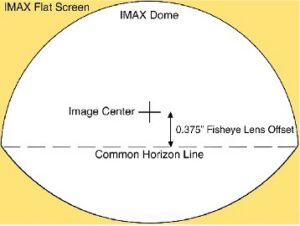
The domes were physically built to match this horizon line, and the Hasselblad 180° Distagon equidistant fisheye lens was physically shifted up 0.375” above the optical center on the 15/65 cameras, in order to place the horizon line in the lower third of the frame. (When an image is captured through a lens to a piece of film, the image on film is inverted. Optics correct the image for the camera operator and viewers. That is why the lens is shifted up and not down.)
This shift retained an on-axis fisheye projection in the dome, eliminating dome distortion in the center seats near the projector. This meant that a horizon shot with any lens: fisheye, rectilinear, telephoto, will always appear straight in the dome as long as it’s positioned on that common horizon line.
In contrast, a fulldome requires an off-axis fisheye projection that creates a bent horizon that appears straight when viewed from any off-center position in a fulldome theater.
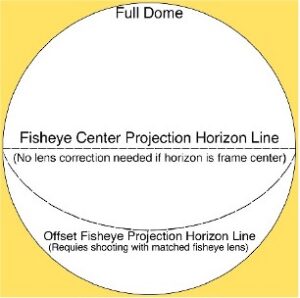
This is essential for truly immersive experiences in fulldomes where the viewer is not facing the center of the dome, but whose seating position and angle places the viewer’s center of vision much lower on the fulldome screen.
This means that the only way to eliminate distortion in the fulldome in camera is to shoot with an equidistant fisheye lens whose angle of view matches the dome’s field of view within a few degrees. Only this lens will allow filmmakers to set a level horizon in camera anywhere in the dome. All other lenses will require very careful framing and/or lens correction in post.
The cameras tested and why they were chosen
We narrowed down the cameras to three, based on their likelihood of providing acceptable image quality and their proven track record in the Giant Screen industry.
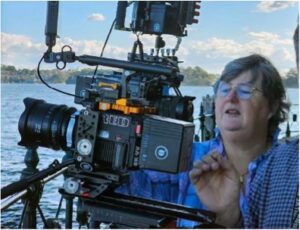
This is Susan Lumsdon, an accomplished Australian Cinematographer, who with her crew and the Australian Cinematographers Society’s Aleksei Vanamois, shot the tests under my direction in and around Sydney in May 2025. Nathan Cohen, IMAX and Giant Screen post production supervisor, was our DIT.
Additionally, The Front, a premiere Sydney camera rental company, supplied the RED Raptor, Sony Venice 2, BMD Ursa 12K LF cameras, as well as Sigma Prime lenses. Pawel Achtel supplied his 9×7 camera, as well as Hal 220 LF and custom Sigma 15mm PL Fisheye lenses. Bryan Smith and Duclos Lenses provided additional Hal 220 LF lenses.
This test would not have been possible without the generous support of everyone mentioned above. I also want to thank Phil Streather for his critical input and continued support as this test became more ambitious than first thought.
The camera comparison test was designed to keep all cameras on a level playing field. Comparative camera specifications and location camera settings are in the Appendix.
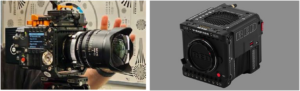
RED has been a leading camera company for Giant Screen photography for over a decade. The latest RED V-Raptor is an 8K 1.89 camera that can shoot at up to 120 fps, which is particularly important for wildlife cinematography. It features internal ND and a small footprint and can accept a wide variety of lens mounts and accessories.
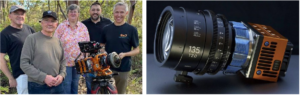
This higher than 8K resolution camera captures a 1.33 aspect image at up to 71 fps. This camera also has a very compact tethered footprint. Uncompressed capture allows for upscaling to 16K equivalence. It is the only camera tested with a global shutter that captures artifact free motion. Many different lens mounts are available including shift-mounts.
Sony Venice 2:
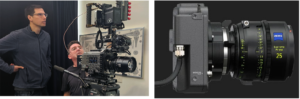
Sony’s flagship camera captures an 8K 1.5 aspect image at a maximum 29.97fps with a 1.5
aspect image. It features in-camera ND filters for faster shooting under varying light conditions. Its sensor block can be removed from the camera body for a tethered camera with a very small footprint.
And, a late additional entry (or three)…
Blackmagic Ursa Cine 12K L
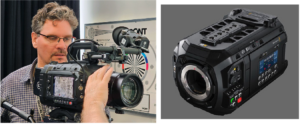
The Ursa is a new 12K 1.5 aspect camera with internal ND. It was also chart tested but there were not enough lenses to do a simultaneous sunset/dusk shot. So, we only had a night shot to compare to the other cameras. Given that the Ursa performed well in the chart and the night shot, an additional test was shot later in Los Angeles, along with Nikon and Canon mirrorless cameras. The results were shown near the end of the camera comparison test.
The location lenses used and why they were chosen
A camera is no better than the lens attached to it, so the choice of lenses was equally important to the image quality in these tests.
As this was a test for original LED Fulldome capture, we opted use two fisheye lenses of different focal lengths, and they had to be not only the sharpest available, but also free of chromatic aberrations, as far out to the edge of the image circle as possible. Due to the off-center fisheye projection, much of the sweet spot ends up getting close to the edge of frame, so the lens chosen had to be of extremely high quality.
As some of the camera tests were also to be presented on a flat 4K IMAX Flat screen at the 2025 GSCA Conference in Austin, we double shot some locations with three Sigma 28mm T1.5 rectilinear lenses.
All lenses used in the test were matched using the Front’s lens projector, to confirm that each respective focal length of lenses was effectively identical in performance to the others.
Here are the two selected lenses:
Entaniya Hal 220 LF 9.1mm T29:
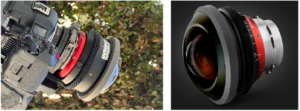
The 9.1mm focal length required installing the 10.47mm thick internal spacer inside the lens. This is the widest focal length available on this lens.
At this setting, and in full frame fulldome presentation, the lens is sharp and comes close to matching the 165° Ft. Worth Dome field of view, putting the Sony Venice and Ursa LF cameras at 155,° the 9×7 at 144,° and the RED Raptor at 139,° inside a square extraction, delivered in 8K x 8K.
Sigma 15mm T1.5 180° Diagonal Fisheye
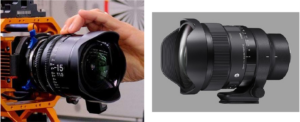
This lens was chosen for two reasons. One is that it is, edge to edge, the sharpest and fastest commercially available fisheye lens in the world, ideal for a camera comparison. Additionally, it is an important alternative lens to use when the wider Hal 220 fisheye reveals crew members and lighting equipment in the frame, or when you can’t get close to the subject.
Longer rectilinear lenses do remain necessary, especially for wildlife cinematography and subject isolation for storytelling and cutting. However, rectilinear lenses are much more forgiving in terms of apparent sharpness, so we focused on these fisheye lenses, of two focal lengths, as the primary concern for these tests.
Test 1: The Yotta Resolution Chart
Resolution Charts can objectively reveal the true resolving power of cameras and lenses in terms of line pairs per millimeter. Because the chart is flat, a longer lens is required to capture it without distortion, so we used the same Sigma 65mm T1.5 PL mount lens on all cameras.
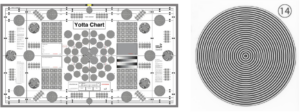
This Yotta chart (above left) is the professional choice world wide for 8K camera rental companies wanting to ensure their cameras and lenses meet the highest standards for image quality.
When photographed from fifty times the focal length of the taking lens, the Yotta chart can indicate the actual resolutions of any lens/camera combination, up to 250 line pairs per millimeter (LP/mm).
However, since this was a camera comparison test, all cameras were aligned to a common top and bottom when framing the Yotta chart. The left and right edges of the sensor frame varied but were all cut off for a square extraction for the LED Fulldome.
In this case, the Yotta chart showed relative camera resolving power, not the absolute value in terms of LP/mm.
The chart’s center test patches (above right) are sets of concentric circles designed to reveal camera aliasing, moiré patterns, and lens astigmatism on every axis. They are numbered from four to fifty-five. The lower the number, the higher the relative resolving power of the camera-lens combination.
These are the results we found (a lower number is better):
The RED Raptor resolved test pattern 11
The 9×7 Camera resolved test pattern 6, significantly better than any other camera. The Venice 2 resolved test pattern 9
The Ursa 12K LF also resolved pattern 9
Modulation Transfer Function (MTF)
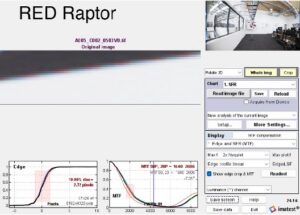
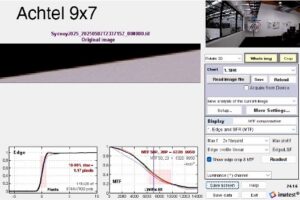
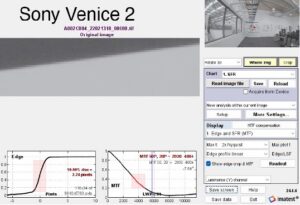
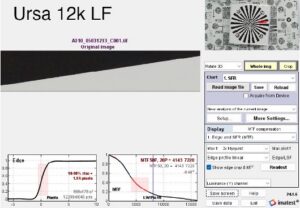
A Siemens Star Chart was shot for each camera and entered into ImaTest, a piece of software that creates a Modulation Transfer Function chart indicating each camera’s resolving power, in lines per picture height. These tests present absolute resolution numbers and were consistent with the Yotta chart results and are presented in full in the Appendix.
The Location Test Shots:
In discussions with Susan Lumsdon we picked three exterior locations that represented the biggest challenges for a high resolution camera in an LED Fulldome. They also represented typical Giant Screen wide exterior shots.
First was Sydney Harbor, with its distinct skyline horizon, bridge, and water in the foreground. Second was the Royal National Forest, with no straight lines but tremendous natural detail, and third, the skyscrapers in the Barangaroo neighborhood, for their straight lines and right angles.
Notes:
Since lens correction can significantly soften parts or all of the image, all test shots are initially presented here in the full frame and without any form of lens correction.
Given the lack of lens correction in this part of the test, a high degree of distortion was visible in the LED Fulldome theater in many of the shots. That was addressed later in the test.
All shots were lightly graded to match overall color. Light (and equal) sharpening was added to all location shots, emulating common DI practices for Giant Screen films.
Due to the differing sensor sizes of the cameras, there were slight variations in the image size on screen.
All camera speeds were set to 30fps to allow a larger group of cameras to be tested, assuming a user needing to deliver 60fps will use motion interpolation in post production.
Sydney Harbor
Sydney Harbor from Milsons Point, Late Afternoon:
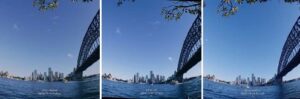
All shot simultaneously on 15mm Sigma Lenses, the RED Raptor, Achtel 9×7, and Venice 2 cameras were each shown with five seconds of black in between, and then cut directly against each other twice.
This test was designed to show how each camera responds to a wide dynamic range of light values later in the day. This included deep shadowed areas, as well as brilliant reflections off buildings and saturated mid-tone colors.
Sydney Harbor from Milsons Point, Magic Hour/Night:
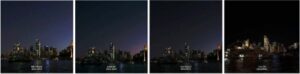
Shot simultaneously on 28mm Sigma Lenses, the RED Raptor, Achtel 9×7 and Venice 2 cameras are each shown with five seconds of black in between, and then cut directly against each other twice. Using one of the same 28mm lenses, we were able to add a pick-up night shot with the Ursa 12K LF camera on another day.
This test looked for how well the cameras did in low light, especially in the sky which was a very dark shade of magic hour blue. Blue is usually the noisiest channel in image capture on a Bayer sensor, and this test revealed how well each camera handled it. All the dusk shots showed some camera noise, but Moonraker supplied a light denoise to all the shots.
There were bright city lights in the shot as well, which tested the cameras dynamic range at the higher end. The audience was asked to look to see which camera brought out the most shadow detail from the practical city lights, and how well they reproduced light point sources as points, before blooming.
Sydney Harbor from Milsons Point, Night:
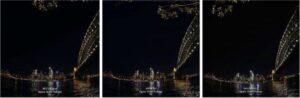
All shot simultaneously on 15mm Sigma Lenses, the RED Raptor, Achtel 9×7, and Venice 2 cameras were each shown with five seconds of black in between, and then cut directly against each other twice.
This was shot after the magic hour light was completely gone, allowing us to see how well the cameras performed in a full night scene. The audience was asked to see which camera brought out the most shadow detail from the practical city lights, and how well they reproduced bright light sources as points, before blooming.
Royal National Forest, Day
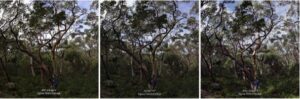
All shot with Sigma 15mm, the RED Raptor, Achtel 9×7, and Venice 2 cameras were each shown with five seconds of black in between, and then cut directly against each other twice.
This was an extreme test of sharpness for cameras due to the intricate detail in the forest branches and leaves. Significantly, lens distortion was far less apparent here due to the lack of any straight lines in this forest environment. Natural settings like this are also very forgiving with longer rectilinear lenses needed for wildlife or underwater cinematography, for the same reason.
Barangaroo Neighborhood, Sydney,
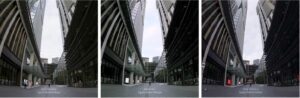
All shot with the Sigma 15mm, the RED Raptor, Achtel 9×7, and Venice 2 cameras are each shown with five seconds of black in between, and then cut directly against each other twice.
This was a good test of sharpness for cameras due to the intricate architectural detail all around. Shadow detail was also important to look for, given that most of the shot is in open shade while sunlit white clouds are visible high in frame.
Contrary to the Royal National Forest, this architectural setting, with lots of straight lines and right angles, made the lens distortion very obvious to audiences.
Summary of Initial Camera Comparison Test
At this point the relative performance of the cameras screened was obvious. Aside from the Achtel 9×7 camera, the RED Raptor and Venice 2 did not look sharp enough in their mission to fill the LED Fulldome. Additionally, distortion in all cameras was very noticeable. It raised two major questions:
Can the image quality be improved?
Can lens correction in post effectively create an offset fisheye projection, eliminating distortion in the center seats?
For answers we needed to explore the next phase of the tests, post production.
Digital Post Production Options:
AI Enhancement
Post production supervisor Nathan Cohen kindly created the next test, which explored what impact modern AI enhancement tools would have on the images, and if that might change how the cameras compare to each other. To keep the scope manageable, Nate focused his AI enhancement test on a single setup: Sydney Harbor late afternoon:
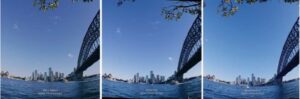
Topaz Video AI was selected as the platform for enhancement because it has been used successfully for Giant Screen films in the past, and has proven to provide good results. Several of Topaz’s models were tested and evaluated in order to determine which was best suited for the Sydney Harbor shot. After this evaluation, Proteus was found to strike the right balance between enhancement and minimal amount of undesirable artifacts.
To match the color grade from the main test, Moonraker VFX of Bristol (our post production partner along with Nathan Cohen Productions) supplied renders with grading applied, but without any denoising, sharpening, or upscaling. These renders were then processed through Topaz using the Proteus model. The images from the RED Raptor and Sony Venice 2 were upscaled to 8K, while the Achtel 9×7, already debayered to native 8K, was enhanced before upscaling. The final render was done at 8192 x 8192 (1:1) to fill the LED Fulldome canvas.
The resulting test that we saw on the 8K LED Fulldome first demonstrated the transformation from original image to the AI enhanced image. We then compared the three cameras against each other, with the AI enhancement applied.
This segment was not intended to be a comprehensive survey of AI enhancement methods, but rather an addendum to the main test – designed to show how AI processing affects the perceived quality of each camera and their relative comparison.
As presented in 8K, the improvement in image quality on the Venice 2 was dramatic, bringing it close to the Achtel 9×7 camera in sharpness. The RED Raptor also improved significantly, although it still wasn’t sharp enough to best be used for wide landscapes.
While AI improvement in the Achtel 9×7 wasn’t apparent in 8K, it has been demonstrated to perform well when upscaled and enhanced at resolutions equivalent to 16K.
Lens Correction
Moonraker VFX generously agreed to do the 8K DI color grade and mastering for these tests as well as the lens corrections. Creating a final lens correction is a complex and expensive process where the actual lens is carefully tested so that the software can accurately map, pixel by pixel, how the fisheye lens captures an image. Our testing didn’t have the time or resources for that, but Moonraker’s Mark Hartshorn used his many years of experience in the fulldome format to create workable lens corrections for these tests.
For lens correction to succeed, the taking lens should be a fisheye, and it needs to be wide enough to cover the fulldome’s field of view, with the lens correction applied.
To achieve the lens correction we used the original footage to its full width, ensuring we had a fulldome field of view. The correction also added a black bar to the top of the image, where there was no additional information available in the image.
Royal National Forest: Sigma 15mm and Hal 220 LF intercut without lens correction:
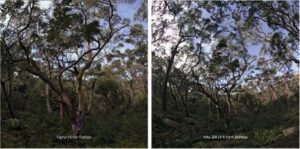
Back in the Royal National Forest, we intercut between the Sigma 15mm and Hal 220 LF
9.1mm lenses, using just the Achtel 9×7.
Although the distortion was much less apparent due to the natural landscape, the wider Hal 220 LF lens still created a more immersive feeling as it is sized much closer to the LED Fulldome’s true field of view.
Barangaroo Neighborhood Sydney: Sigma 15mm and Hal 220 LF intercut without lens correction:
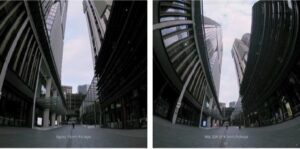
In the surrounding buildings the distortion in the longer Sigma 15mm lens was very apparent, while the wider Hal 220 LF had far less distortion, as it is closer to the dome’s true field of view. Looking up at the top of frame center, the tall buildings were only slightly bent upwards, while the Sigma 15mm buildings were bent completely out of frame.
…and then directly intercut without and with lens correction
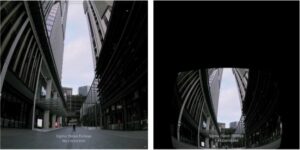
Sigma 15mm
We noticed that the Sigma 15mm still had some distortion despite the correction, and was only able to fill a small part of the fulldome frame because the lens is too long to capture most of the missing information. The lens could be corrected a little more aggressively, but that would shrink the image size even more. There are no free lunches in the fulldome!
Hal 220 LF 9.1mm
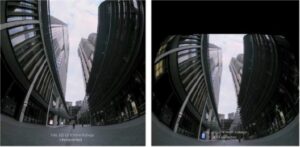
In contrast, when viewed in the full dome, the corrected Hal 220 LF lines were straight, and the buildings rising up to the top of frame had almost no distortion. There were still curvature issues at the extreme left and right side of frame, but straightening the edges of the fisheye is easier once a lens has been properly mapped for lens correction.
Notice that there is a black bar at the top of the frame where the correction ran out of image information.
Also notice that the horizon line is now much lower in the frame. When the lens correction process ran out of image information it had to bring in the edge of frame or fill it with black. This means that original capture must be framed with lens correction in mind, by placing the horizon line considerably higher in frame than the deliverable horizon line. And don’t forget that the image won’t fill the fulldome frame top after lens correction.
But wait…there’s more!
In the course of these tests we noticed that the shrinking of the image in the lens correction process boosted the apparent resolution of all the cameras. With that in mind, we decided to do a supplemental test in Los Angeles to tie up some loose ends.
First, we wanted to see more tests of the Ursa 12K LF camera, that we weren’t able to shoot in Sydney.
Second, we wanted to test guerrilla filmmaking friendly mirrorless cameras to see how they would perform. The 8K Canon R5 C mirrorless and 8K Nikon Z8 cameras were added to the list, as they have been used successfully in a number of Giant Screen films.
And lastly, we wanted to use AI frame extensions to fill in the missing top of the frame.
Los Angeles Residential Street, Day
This location was selected for its mixture of architectural straight lines, including telephone poles, as well as highly detailed leaves, bushes and trees.
Full Dome Framing
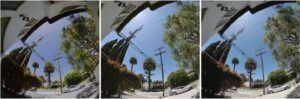
Using the same Hal 220 LF 9.1mm Fisheye lens, the Ursa 12K LF, Canon R5 C, and Nikon Z8 cameras were each shown with five seconds of black in between, and then cut directly against each other twice.
With Lens Correction:
Same shots, but using the entire 1.5 and 1.78 original frame width and adding lens correction. The cameras were each shown with five seconds of black in between, and then cut directly against each other twice
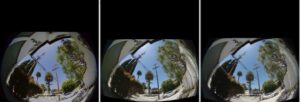
Just like the skyscrapers in Sydney, the lens correction cannot fill the top of the frame. The Ursa looked sharper and did a bit better filling the frame because of its 1.5 aspect sensor, versus 1.78 for the Canon and Nikon. In terms of distortion, the shots all looked pretty good, with the telephone pole and trees appearing to be straight. There was some distortion at the edges, but as stated before, those are issues that a proper lens mapping can fix.
With lens Correction and AI frame extension:
Tim Sassoon of Sassoon Film Design very kindly created the frame extensions in Adobe Photoshop, using a one sentence AI prompt. A few iterations were tried, in each case taking less than a minute for the computer to create and render it at 8K. The arched gate top right in the live action plates was digitally removed in After Effects to fool the AI into making a better extension. Tim then composited the final AI extension into the shots in After Effects.
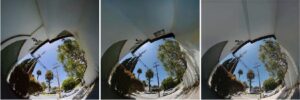
The cameras were each shown with five seconds of black in between, and then cut directly against each other twice.
By facilitating the use of the full image width from each camera, the shots looked good on the fulldome and could still be improved further using AI enhancement tools.
Final Conclusions:
By applying all of today’s lens, camera, and digital post technology, all the cameras tested have a place in immersive documentary style shooting in an 8k fulldome. The devil is in the details, and with so many new cameras and technological advancements coming along, testing the entire capture through post pipeline before every new project is essential.
The Achtel 9×7 had unmatched fulldome image quality when compared directly with the other cameras. It can also future proof content for higher resolutions than 8K x 8K. Next up for image quality would be the Sony Venice 2 with the Ursa 12K LF close to it (more testing is warranted), followed by the Red Raptor and the mirrorless cameras .
While the RED Raptor VV had the lowest apparent resolution of the main cameras tested, it alone offers 120fps capture, important to wildlife photography using longer lenses, which are far more forgiving with resolution. The RED Raptor also responded well to AI enhancement of the image quality, but not enough to be a good choice as a wide landscape, single sensor camera on the 8k LED Fulldome. Cameras that can shoot at 48, 60, or 120 frames per second have a big advantage in the fulldome world. 120 fps capture can be used to create 24, 30, and 60 fps project frame rates that are cross compatible with many other formats. 48 fps in particular is backwardly compatible with IMAX Dome at 24 fps.
Uneven frame multiples still lead to unpleasant motion artifacts when motion scaling, and should be avoided.
AI Enhancement significantly raised the image quality bar for cameras. However, testing is needed on a camera/lens combination to confirm an acceptable LED fulldome image quality before principal photography. Both the lens and camera need to be tested.
Lens corrections can be done in post, but come at a cost of not filling the fulldome frame. They also require careful planning as horizon lines will drop lower when more correction is applied.
AI (like traditional) frame extensions boosted the apparent resolution of all cameras by allowing all of the original camera’s image width to be used in the fulldome.
More NITs and higher frame rates are better in the long term. The camera tests were mastered at 100 NITs (29.2 Foot Lamberts) in order to be consistent with the other GSCA films presented on the Fort Worth LED Dome. Mastering at 100 NITs allows producers to do the least amount of remastering for an LED screen. However, as original LED content revealed, images presented on the LED dome at 200 and 500 NITs were significantly more impressive compared to 100 NITs. Additionally, higher presentation frame rates such as 48 and 60 fps are essential to a brighter, non strobing picture. Filmmakers can also use as much or as little brightness as they want by design.
Recommendations:
Creating a common standard for LED Fulldome theaters moving forward is essential. There are no LED Fulldome standards at present. There are wildly different seating arrangements, unstandardized horizons, and different dome shapes and fields of view. A common standard makes more films available to more venues at lower costs and higher production value. The institutional IMAX/Giant Screen business model success was made possible by consistent standards, and new standards are needed as soon as possible.
Upward Compatibility is the model for moving from IMAX Dome to LED Fulldome.
Based on the full length films screened at the Fort Worth GSCA conference, the overwhelming consensus was that supplying COSM with a 6K 1:43 dome master, containing AI image quality enhancement and frame interpolation from 24 fps to 48 fps, created an excellent experience in the Fort Worth LED Fulldome by using the COSM warping program. This program levels the IMAX common horizon line and upscales the image to 8192 pixels wide and roughly 5200 high. In the Fort Worth LED Fulldome Theater, COSM demonstrated their warping process with the Imagica “Sacred IMAX/Dome Master,” confirming that the common horizon appears straight and every part of the IMAX Dome frame is visible on the Fort Worth LED Fulldome screen. The trade-off was that the LED Fulldome was not filled to the top. The better an IMAX Dome film looks on an an IMAX Dome, the better it will look on the LED Fulldome presented in this manner.
The horizon line of a film needs to be designed into the visual storytelling by the cinematographer and director. Not just technically, but aesthetically too. Higher horizons allow filmmakers to use the format more immersively. For example, audiences in a dome theater will naturally direct their view to the horizon for orientation. A low horizon means about a third of your vision is filled with off-screen information at the bottom, like seats and railings. Imagery at the top of frame is excluded from view. Adjusting the horizon higher places nearly all of the viewer’s attention within the fulldome itself, and the inclined seating in the dome makes it comfortable to do so. Once a higher horizon is set it should become the level standard for a given film, and modern audiences will still accept editorial deviations from this, like cutting to a straight down shot.
VR Headsets are essential for pre-visualizing lenses, shots, and CG in a virtual fulldome. Apps like Whirligig and Festoon work with affordable VR headsets like the Quest 3s, and Festoon can also create a virtual IMAX Dome venue as well as customization options.
By using a shifting lens mount, partial fisheye and fulldome images can be captured and used without the need for lens correction or AI extensions in post, and at 7680 x 7680 resolution.
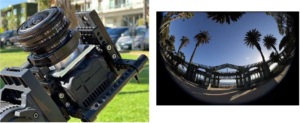
Above, a Canon R5 C with the lens physically shifted down, raises the bottom of the fisheye image circle into frame, as seen on the right. The camera is mounted right side up on one of two quick release plates, each spaced equal vertical distances from the lens center of camera.
Below, the same lens-shifted Canon R5 C is rotated 180° upside down around the optical axis of the lens, lowering the top of the fisheye image circle into frame. As both sides are rotated around the lens axis, there is no parallax in the image pairs, if the rig is properly aligned:
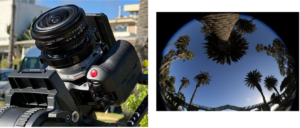
Because the full image circle is fully captured by the flipped camera, lens correction is not needed in post.
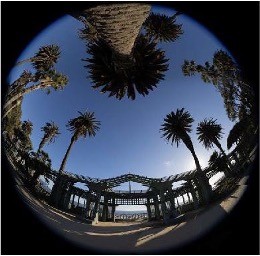
The final image, shown above, was screened in 8K x 8K as a still image filling the Fort Worth LED Fulldome. Compositing can be done with a simple soft split in the DI process. Linear camera moves can be achieved if carefully executed. Admittedly, this approach has a lot of constraints, like wind motion and changing clouds and light, but it brings shooting for the LED Fulldome into the hands of lower budget documentary filmmakers.
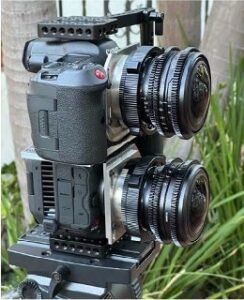
Depending on the budget and schedule, lens shifting can be done with any of the cameras we tested, which can include stacking shifted cameras like this for camera motion on drones and other camera platforms:
Camera comparison test availability
Still frames in the form of TIFFs and Jpegs as well as full 8K x 8K motion files will be made available in the near future.
Further Testing
Shooting fulldome with backward compatibility to IMAX Dome and IMAX flat screens.
A number of GSCA members have brought this up, and it warrants testing. The upward compatibility of the IMAX Dome format to fulldome is pretty straightforward, because it doesn’t try to fill the fulldome screen. Counterintuitively, going the other way is not as simple as it might seem, as it will constrain where the horizon can be placed in the fulldome. Additionally, the technical challenge may pale compared to the creative issues raise by trying to design one shot to work in three very different formats. But, that’s what testing is for!
More extensive frame rate scaling tests.
While frame rate scaling has been largely accepted for Giant Screen films, it is important to explore its limits further and deliberately try to ‘break the machine.’ Breaking waves, flowing water, and moving hair can all present problems, and it would be good to see what those limits clearly are for filmmakers.
One last question…
What fisheye lens can I shoot with on which camera and not worry about distortion in a fulldome?
At the beginning of the Appendix, immediately following, there is a list of all cameras tested, paired with an equidistant fisheye lens (or two) that will put a 180° FOV just inside the top and bottom image area of each camera we tested.
Appendix
Existing 180° equidistant fisheye lenses that can vertically fit each camera tested
(single sensor full dome coverage, lens center mounted).
Note that this is for a 180° fulldome, not 165° like Fort Worth. 180° is compatible with most fulldome theaters as the image can be slightly cropped to fit theaters like the Fort Worth LED Fulldome. Keep in mind that the Entaniya Hal 220 PL lens is not the same as the Entaniya Hal 220 LF lens!
RED Raptor VV:
Entaniya Hal 220 T3.5 PL (PL Mount) with M3-ZR-350 spacer creates a 6.99mm Focal Length that puts a 180° image circle at 21.6mm tall (test to confirm as a slightly wider or tighter spacer might be preferable). 4320 x 4320 resolution.
Achtel 9×7:
Entaniya Hal 220 T3.5 PL (PL Mount) with M3-ZR-250 spacer creates a 7.26mm Focal Length that puts a 180° image circle at 22.4mm tall (test to confirm as a slightly wider or tighter spacer might be preferable). 7000 x 7000 resolution.
Sony Venice 2:
Entaniya Hal 220 T3.5 PL (PL Mount) with M3-ZR-100 spacer creates a 7.7mm Focal Length that puts a 180° image circle at 24mm tall (test to confirm as a slightly wider or tighter spacer might be preferable). 5760 x 5760 resolution.
Laowa 8-15mm T2.9 (PL mount) at 8mm focal length, zoom to best fit. 5760 x 5760 resolution.
Ursa 12k LF:
Entaniya Hal 220 T3.5 PL (PL Mount) with M3-ZR-100 spacer creates a 7.7mm Focal Length that puts a 180° image circle at 24mm tall (test to confirm as a slightly wider or tighter spacer might be preferable). 8000 x 8000 resolution.
Laowa 8-15mm T2.9 (PL mount) at 8mm focal length, zoom to best fit. 8000 x 8000 resolution.
Canon R5 C:
Entaniya Hal 220 T3.5 PL (PL Mount) with M3-ZR-725 spacer creates a 6.14mm Focal Length that puts a 180° image circle at 19mm tall (test to confirm as a slightly tighter spacer might be preferable). 4320 x 4320 resolution.
Nikon Z8:
Entaniya Hal 220 T3.5 PL (PL Mount) with M3-ZR-550 spacer creates a 6.51mm Focal Length that puts a 180° image circle at 20.2mm tall (test to confirm as a slightly wider or tighter spacer might be preferable). 4644 x 4644 resolution.
Comparative Specifications for all Cameras Tested:
RED V-Raptor 8K VV
Sensor Size: 40.96 x 21.6 mm CMOS Max Resolution: 8192 x 4320 (1:89)
Max Frame Rate: 120 fps
Internal ND: Optical, 7 Stops, Clear
Shutter: Rolling
Media: CFexpress Type B (CFast 2.0)
Dimensions (WxHxD): 4.55 x 4.25 x 5.89″ / 115.5 x 108 x 149.63 mm Weight: 7.99 lb / 3.62 kg (Body Only)
Lens Mount: Interchangeable, comes with PL mount Battery Mount: V Mount or Gold Mount
Achtel 9×7
Sensor Size: 29.9 x 22.4mm CMOS Max Resolution 9344 x 7000 (1.33) Max Frame Rate 60fps
Internal ND: No
Shutter: Global
Media: Proprietary internal storage located in a separate recording module Dimensions: (WxHxD) Camera head: 80x 80mmx 70mm, recording unit: 136 x 166 x 66mm
Weight: Camera Head: 1.54 lbs./.7 Kg Recorder Unit: 5.51 lbs./2.5 Kg
Lens Mount: Interchangeable LPL, PL, PV, Nikon, and Leica-M.
Battery Mount: V Mount
Sony Venice 2
Sensor Size: 36.2 x 24.1 mm CMOS
Max Resolution 8640 x 5760
Max Frame Rate 29.97 fps
Internal ND: Optical, 8 Stops, Clear
Shutter: Rolling
Media: Dual Slot: AXS-A, Single Slot: SD/SDHC
Dimensions (WxHxD): 9.84 x 6.22 x 5.98″ / 249.94 x 157.99 x 151.89 mm Weight: 9.5 lb /4.3 kg (Body Only)
Lens Mount: Comes with PL with eMount recessed inside Battery Mount: V Mount or Gold Mount
Blackmagic URSA Cine 12K LF
Sensor Size: 35.64 x 23.32 mm CMOS Max Resolution 12,288 x 8040
Max Frame Rate 59.94
Internal ND: Optical, 6 stops, Clear
Shutter: Rolling
Media: Internal Swappable 8TB BMD SSD Media Module Dimensions (WxHxD): 11 x 6 x 6″ / 27.9 x 15.2 x 15.2 cm
Weight 8.72 lb. / 3.96 kg (Body Only)
Lens Mount: Interchangeable, comes with PL Battery Mount: B-Mount
Canon R5 C
Sensor Size: 36 x 24mm CMOS
Max Resolution 8192 x 4320
Max Frame Rate 59.94 fps
Internal ND: No
Shutter: Rolling
Media: CFexpress Type B
Dimensions (WxHxD): 5.6 x 4 x 4.4″ / 142.2 x 101.6 x 111.8 mm Weight: 1.7 lb. / 770 g (With Battery, Recording Media)
Lens Mount: Canon RF
Battery: Canon LP-E6NH
Nikon Z8
Sensor Size: 35.9 x 23.9 mm (Full-Frame) CMOS Max Resolution 8256 x 4644
Max Frame Rate 59.94 fps
Internal ND: No
Shutter: Rolling
Media: CFexpress Type B
Dimensions (WxHxD): 5.7 x 4.7 x 3.3″ / 144 x 118.5 x 83 mm Weight: 2.0 lb / 910 g (With Battery, Recording Media)
Lens Mount: Nikon Z
Battery: Nikon EN-EL15c
Camera Location Settings:
Shutter angle was used in lieu of ND filters to avoid color shifting and fisheye mounting limitations.
All cameras were set at ISO 800 (except Venice 2 at 3200 ISO for the night shot only)
Milsons Late Afternoon: Red Raptor, Venice 2 at T5.6; 9×7 at T4.5 (to avoid diffraction) Milsons Dusk: Red Raptor, Venice 2, 9×7 at T2.8
Milsons Night: Red Raptor, 9×7, Venice 2, Ursa 12K LF all at T2 Royal Nat’l Forest: Red Raptor, 9×7, Venice 2 all at T4.5
Barangaroo: Red Raptor, 9×7, Venice 2 all at T4.5
Los Angeles: Ursa 12K, Canon R5 C, Nikon Z8 all at T5.6
Modulation Transfer Function (MTF):
MTF is a measure of an optical system’s ability to transfer contrast from an object to an image, and it indicates the system’s spatial resolution and image quality. It’s typically represented as a graph showing how contrast (modulation) changes with increasing spatial frequency (detail level). A higher MTF means better detail reproduction, while a lower MTF indicates that finer details become blurred in the image. It is the most accurate and scientific way to establish a camera’s true resolving power, and it doesn’t require a screening!
Look for the red letters/figures in the charts below: MTF 50P, 20P = Line Widths per picture height:
Special Thanks
ACS Australian Cinematographers Society: Aleksei Vanamois
Sydney Crew: Susan Lumsdon, Director of Photography Anthony Manion 1st Assistant camera Elena de Bruijne Assistant camera
The Front, Sydney: RED Raptor, Sony Venice 2, BMD Ursa 12K LF Cameras and Sigma Prime Lenses and Camera Support
Pawel Achtel/Achtel Ltd.: Pawel Achtel, Achtel 9×7, Entaniya Hal 220 LF Lens, Sigma 15mm PL Fisheye Lenses
Duclos Lenses: Entaniya Hal 220 LF
Bryan Smith/Reel Water Productions Ltd.: Entaniya Hal 220 LF
DIT Services: by Nathan Cohen Productions
Digital Mastering: Moonraker VFX – Simon Clarke, Mark Hartshorn
AI Extensions VFX: Tim Sassoon, Sassoon Film Design
AI Camera Resolution Upscaling: Nathan Cohen Productions
Encoding: COSM
Produced By:
Sean MacLeod Phillips ASC
Phil Streather
Michael Daut
Nathan Cohen